|
||||||||||||||||||||||
|
||||||||||||||||||||||
 |
|
|
Germicide Test Strips WaterCheck CP
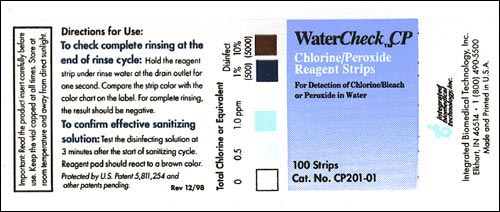
Bleach chlorine or peroxide solution are commonly used for disinfection of medical instruments or equipments, such as dialysis machines or water purification system. After the disinfection, the chemical is then rinsed off with deionized water or RO water before the instruments or the water system can be returned to service. In the commercial Bleach solution, it usually contain 5.25 or 6.0 % of sodium hypochlorite. The chlorine is in the form of free available chlorine and reacts as an oxidant The peroxide based sterilant usually contain a mixture of peroxyacetic acid (peracetic acid or PAA) and hydrogen peroxide. Peracetic acid is a much stronger oxidant and is the main chemical for sterilization effect. Both peroxide chemicals, however, react equally with the WaterCheck CP test strip. The WaterCheck CP test strip is a most versatile, all-in-one test strips for chlorine, peroxide or peracetic acid. WaterCheck CP strip will also react with high levels of chlorine to a distinct brown color. The strip can be used as a residual as well as potency test strip for chlorine.
1. Fast and sensitive.
2. Very consistent
3. Easy to read colors
4. Residual and potency strip in one
5. Long shelf life, stable at room temperature
The strip is primarily designed for use in hemodialysis disinfection control. However, it can also be used in different applications. For disinfection of dialysis machines, bicarbonate mixing tanks or water distribution system, the final rinse water should have none or less than 0.5 ppm of residual chlorine according to the AAMI standards. The simple strip test can verify the compliance of the water quality.
Interpretation of the test results depends on the nature of the testing. Chlorine Tests: If measurement of a more accurate chlorine level is desired, a 5 second test procedure should be followed by holding the strip under a slow running test water for 5 seconds and comparing the strip color with the color chart immediately. The strip color will be intensified at the end of 5 seconds. The length of the contact time of the strip with fresh test sample determines the final intensity of the strip color. The longer the contact time, the darker the strip color will be. The actual strip color may vary depending on how the test is done and the lighting condition of the room. The residual color blocks on the label are standardized with the 15 second test procedure and is considered semiquantitative only.
The strip is the most commonly used in detecting chlorine in water. However, the strip can also be used for detecting chlorine in other media, such as dialysate or bicarbonate solutions. In the blood, plasma or serum, chlorine will reacts with blood components such as ascorbic acid or other antioxidants, also with serum proteins and reduce the detectable chlorine level. What is detected in such media is the remaining of the chlorine rather than the initial level of chlorine contamination. In urine, chlorine will react with ammonia decomposed from urea and form chloramine. Chloramine is much more stable than free chlorine and can be detected with the strip after weeks of storage in the refrigerator. In organic solvents or oil, the presence of chlorine can also be detected by the strip. Results with all media other than clean water should only be interpreted as qualitative.
Since the test is based on the oxidative election transfer of chlorine molecules, chlorine will reacts to a variety of indicator system of different chemical properties. Because of this, not all the chlorine tests are created equal even when the same chemical indicator is used. They all differ in detection sensitivity, detection range, chemical specificity and thermal stability. IBT offers three chlorine test strips for different applications. The following table compares the main features and the suggested applications of each strip.
There are many other test strips which will react with chlorine but lack the sensitivity required for hemodialysis or other critical quality water applications. For detailed explanation, refer to the IBT Bulletin #402 “The Most Commonly Misused Chlorine Test Strips”
The WaterCheck CP test strips are packaged 100 strips in a bottle and 6 bottles in a box.
Order by phone, fax or email. Contact our Customer Service for more information or technical support. Customer Service: R: ec103
|
|
||||||||||||||||||
|
||||||||||||||||||||||
© 2010 Integrated Biomedical Technology.
All rights reserved. 2931 Moose Trail, Elkhart, IN 46514 U.S.A. |
||||||||||||||||||||||